How to Play Against an Opponent Who Gives You No Pace
Slow balls create a different tactical problem. Learn when to build, when to take time away, and when to move forward.
You can play your best tennis against someone who hits hard.
Then you face someone who gives you almost nothing.
The ball comes over slowly. Maybe it floats. Maybe it lands deep without much pace. You have plenty of time, but suddenly your forehand feels harder to time.
You swing bigger.
The ball goes long.
This is a different tennis problem. Against pace, you can redirect some of what comes toward you. Against a slow ball, you have to create more of the shot yourself.
The solution isn't simply to swing harder.
First, identify what the ball is actually giving you.
Three Slow Balls, Three Different Responses
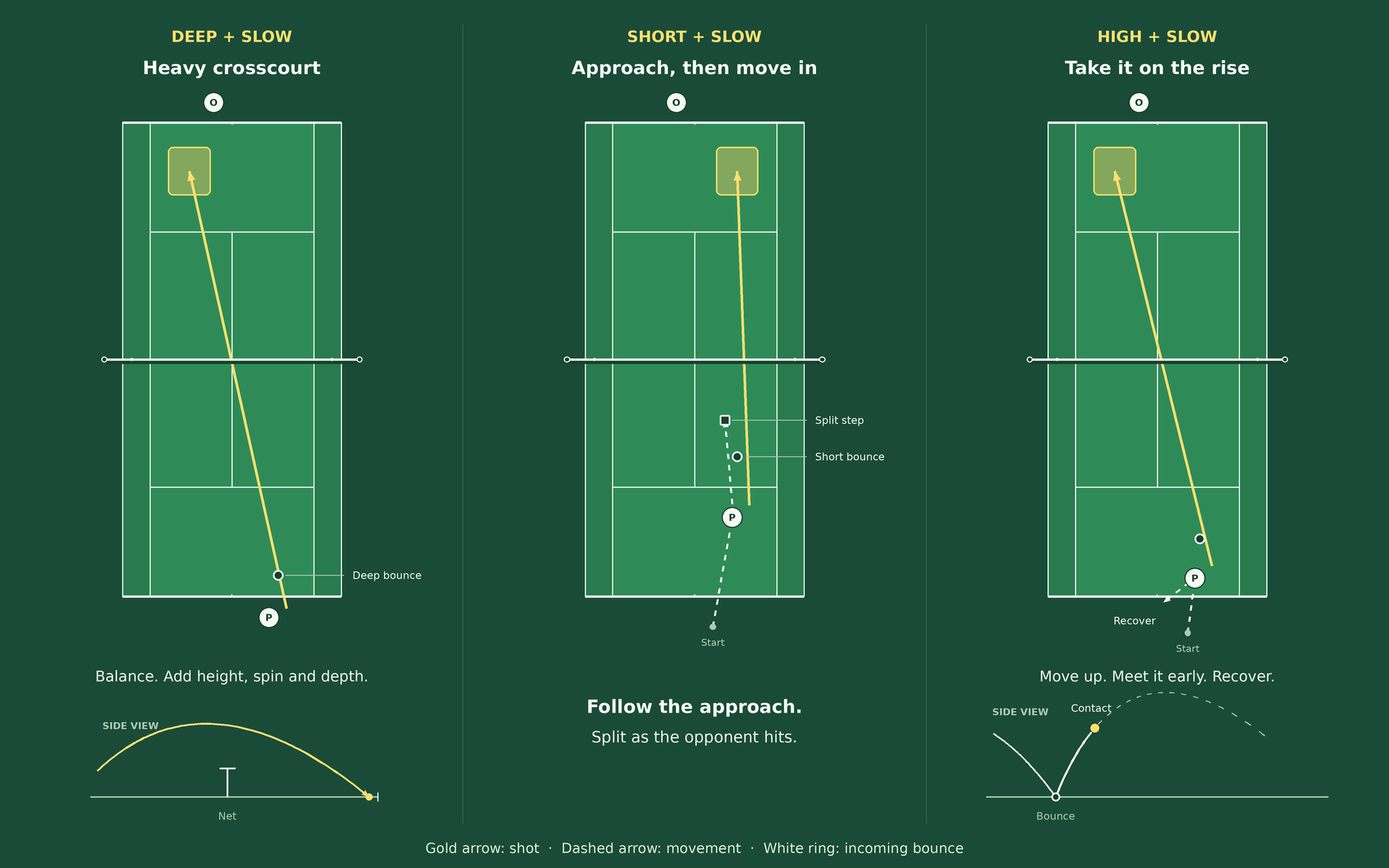
Deep and Slow
The ball lands close to the baseline but doesn't have much pace.
Don't try to crush it just because you have time.
Use the time to get balanced and create your own depth.
Play: Heavy, high-margin crosscourt.
Your first goal is to put the opponent back under pressure. If they give you another comfortable ball, you can continue the pattern.
Short and Slow
Now you have a different opportunity.
If the ball lands around the service line or shorter and you can reach it comfortably, move forward.
Don't automatically go for the winner.
A deep approach shot can be much more valuable than a low-percentage attempt at the corner. From there, close the distance and prepare for the passing shot.
Play: Deep approach → move forward → split step.
Approaching after a short ball is a well-established way to take time away and change the geometry of the point.
High and Slow
This is where players often get caught waiting.
The ball rises high, and instead of moving forward to meet it, they let it drop and end up playing from farther behind the baseline.
If you're balanced and the ball is giving you enough time, take it earlier.
You don't need to hit it harder. You're taking away the opponent's recovery time.
Play: Move forward → take the ball on the rise → recover.
The USTA's progression for taking balls on the rise uses deep balls taken early and midcourt balls taken on the rise, which is a useful way to practice this without making every slow ball an aggressive shot.
Don't Let the Extra Time Work Against You
One thing I watch for with players who struggle against slow balls is late preparation despite having more time.
The player waits for the ball to come to them.
Then they have to make a big adjustment at the last second.
Instead, use the extra time to get your body organized.
Split.
Move.
Set your spacing.
Then swing.
This is especially important when the ball has little incoming pace. You're not getting much help from the ball, so your footwork and spacing have to create the conditions for a good contact.
A simple progression works well here:
Self-feed → partner feed → live ball.
Start by generating your own ball from a self-feed. Then have a partner send slow balls from the other side. Once the movement and contact feel comfortable, play points where the opponent can vary the ball.
The progression matters because each step adds another layer of uncertainty. First you learn to create the ball yourself. Then you have to adjust to someone else's feed. Finally, you have to recognize the right response without knowing what's coming.
Don't Attack Just Because You Have Time
This is probably the biggest trap.
A slow ball can feel like an invitation to hit a winner.
But time and opportunity aren't the same thing.
If you're balanced inside the court and the ball is comfortable, attack.
If you're still behind the baseline, contacting high above your normal strike zone, or reaching the ball late, build instead.
One useful pattern is:
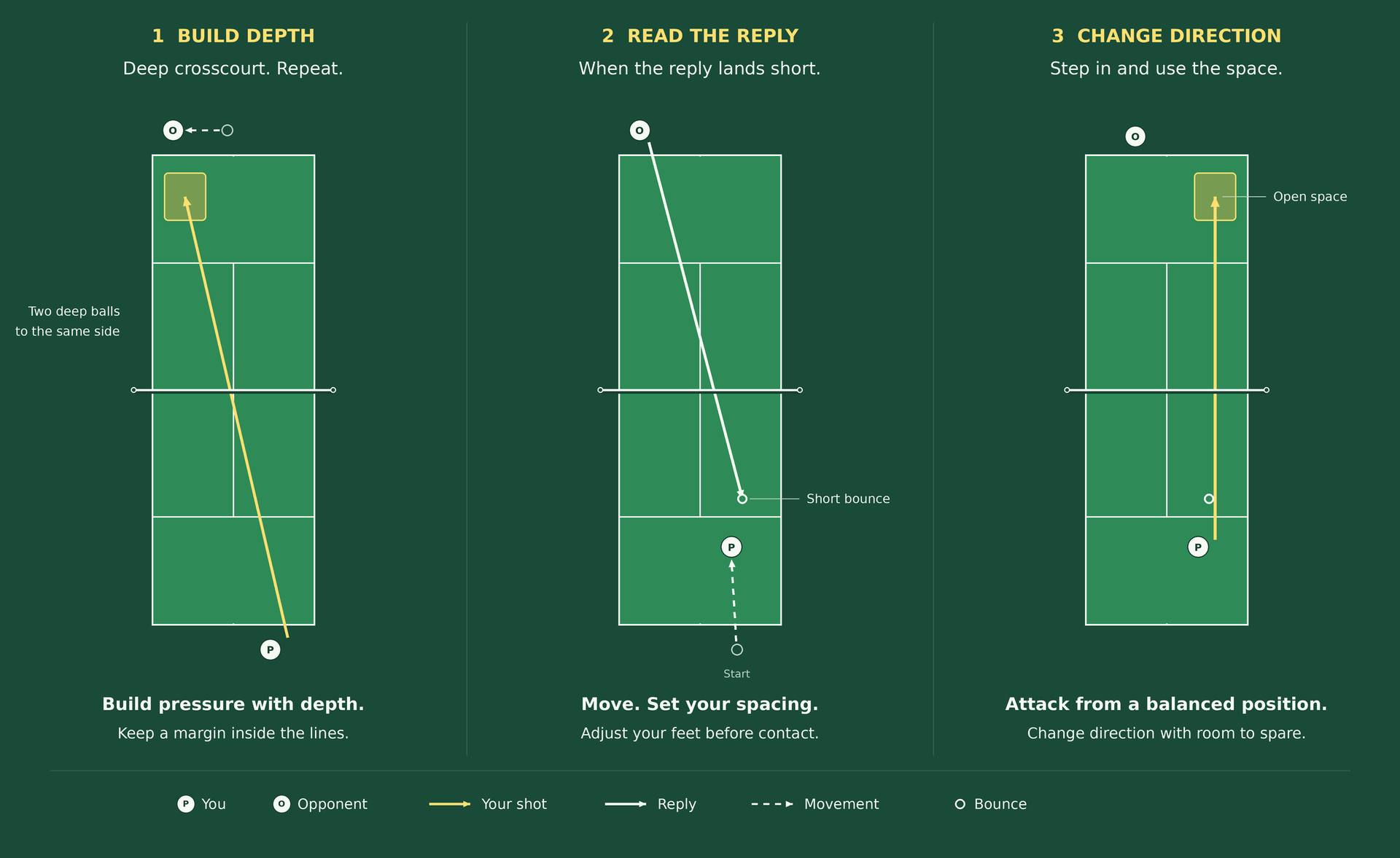
Deep crosscourt → deep crosscourt → shorter reply → change direction.
The first two balls aren't wasted opportunities.
They're what create the third.
That's the part I want players to understand. You don't have to attack the ball that gives you time. You can use that time to create a better ball.
Make the Court Smaller for Them
Once you've handled the slow ball, start looking at the opponent.
If they're comfortable behind the baseline, keep them there.
If you've moved them wide, don't immediately give them the middle again.
If you've pulled them forward with a shorter ball, be ready for the next shot.
The objective isn't to hit a different shot every time.
It's to make them play from a less comfortable position.
That's where a slow-ball opponent can start giving you the opportunities you were trying to force earlier.
A Drill I'd Use
The Three-Ball Slow-Ball Drill
Start with a crosscourt rally.
The feeder sends a slow ball.
Ball 1: Player must hit deep crosscourt.
Ball 2: Player repeats the pattern unless the ball is short enough to attack.
Ball 3: If the player receives the right opportunity, they change direction and move forward.
Then play the point out.
After a few rounds, make the feed random. Some balls should be deep, some short, some higher.
Now the player has to recognize the situation instead of knowing the answer in advance.
That's the important progression.
Don't practice a response. Practice recognizing when the response is appropriate.
Take It Into Your Next Match
When someone gives you very little pace, don't change your entire game.
Use these three responses:
Deep + slow: Create your own depth.
Short + slow: Approach and move forward.
High + slow: Take time away when your position allows it.
Then let the next ball tell you what comes next.
The goal isn't to hit harder than the opponent.
It's to make better use of the time they're giving you.
EXPLORE MORE