
Consistency Is a Decision Skill as Much as a Stroke Skill
Before you rebuild a stroke after a miss, make sure the stroke was given a reasonable job.

When something stops working under pressure, our first instinct is usually to fix the machinery.
Tennis players do the same thing.
A forehand misses long and suddenly you're thinking about your follow-through. A backhand finds the net and you're telling yourself to get lower. Two returns go wide and now you're shortening the swing.
Sometimes the technical correction is necessary.
But if the same strokes work reasonably well in practice and become unreliable in matches, there is another place worth looking:
The decision you made before the swing.
Not Every Error Is a Stroke Error
Consider two forehands.
On the first, you're balanced behind the baseline, receive a neutral ball, and hit crosscourt toward a large target.
On the second, you're moving backward, contact is high and uncomfortable, and you try to redirect the ball down the line near the sideline.
You could miss both shots with the exact same swing.
But they're not the same error.
The first may be an execution error: the decision made sense, but the stroke didn't deliver.
The second may be a decision error: the target demanded more precision than the situation justified.
That distinction matters.
Research on unforced errors has long pointed to the importance of depth, lateral targets, spin and shot direction in reducing errors.
One particularly useful takeaway is that changing the direction of the incoming ball can increase the difficulty of controlling the outgoing ball.
For an adult player, the practical question isn't:
“How do I stop missing?”
It's:
“Am I asking the shot to do something this situation actually allows?”
Margin Is a Tactical Decision
Players sometimes hear “play with more margin” and interpret it as:
Hit softer.
That's not what margin has to mean.
Margin can come from several places:
- More clearance over the net.
- More distance from the sideline.
- A larger landing area.
- More spin.
- Choosing crosscourt instead of changing direction.
- Accepting depth rather than trying to find the last foot of the court.
You can still swing confidently.
You're simply giving normal variation in your stroke somewhere to go.
That variation is real. Research on skilled tennis players shows that where a ball lands naturally varies even when players are aiming at a specific target.
The researchers argue that understanding this distribution matters when choosing targets and making tactical decisions.
In other words:
The target should account for the shot you can reliably produce—not the best shot you occasionally produce.
That is a very different way to think about consistency.
Let the Incoming Ball Set the Risk
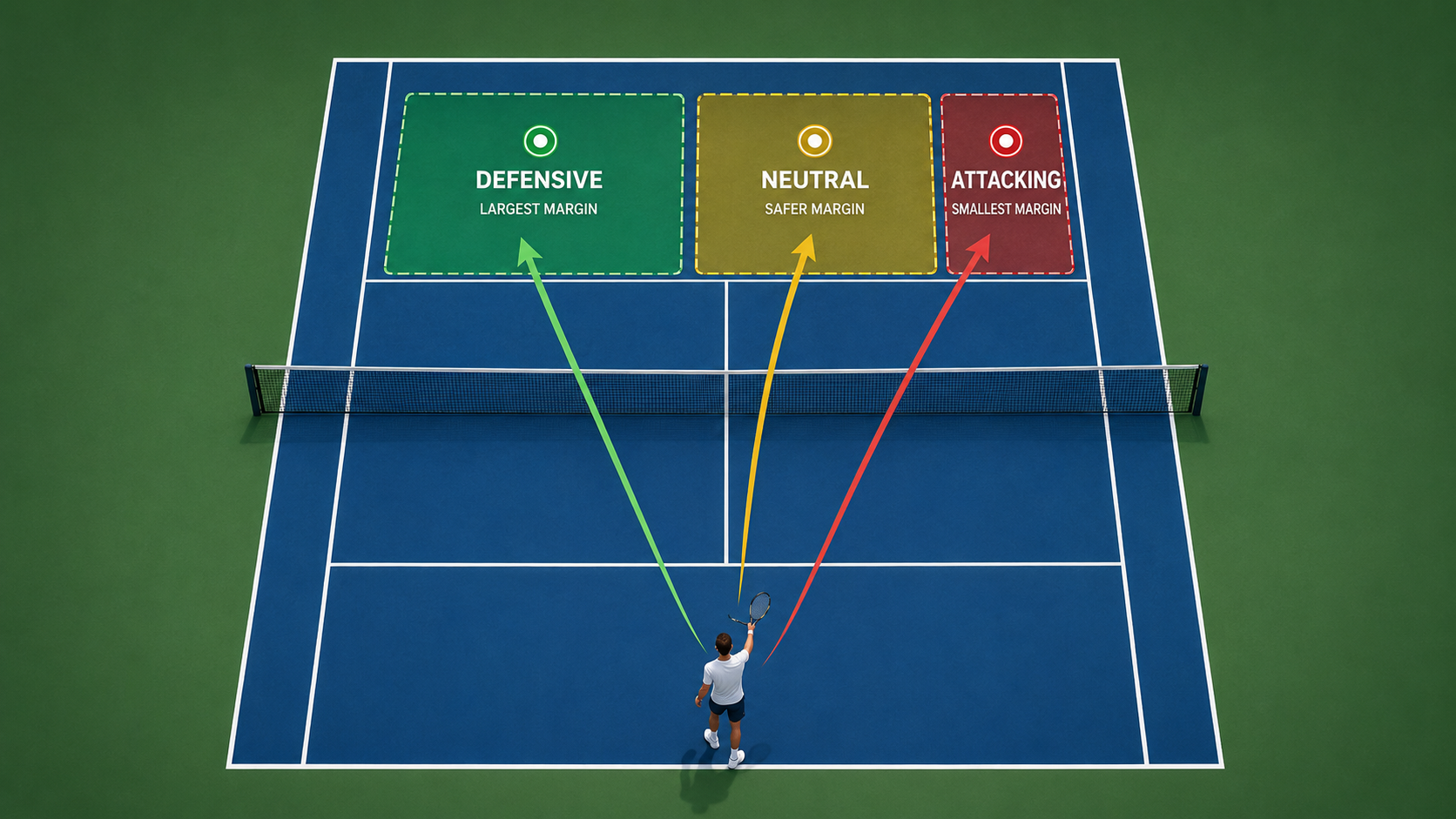
A simple way to organize this is:
Defensive Ball → Recover the Point
You're stretched, late, pushed back or contacting from an uncomfortable position.
Your priority isn't creating offense.
It's buying enough time and space to recover.
Think:
Height. Depth. Bigger target. Recover.
Neutral Ball → Build the Point
You're balanced, but the ball hasn't given you a clear advantage.
This is where consistency becomes a tactical weapon.
Use repeatable targets. Make your opponent solve another ball. Maintain your court position.
You don't need to turn every neutral exchange into offense.
Offensive Ball → Reduce the Margin Intelligently
Now the ball is shorter.
You have better spacing.
You're inside or moving into the court.
The opponent may be out of position.
Now there is a reason to accept more risk.
The mistake isn't aiming aggressively.
The mistake is
using an attacking target from a defensive situation.
This is one of the simplest ways to understand consistency:
Your target should change with the quality of the ball you receive.
Stop Creating a New Point Every Time
Consistency also improves when you don't have to invent every decision.
Suppose you establish a dependable pattern:
Deep crosscourt → recover → repeat crosscourt → attack the shorter reply.
That pattern isn't a rule.
If the opponent changes the situation, you change with it.
But the pattern gives you a reliable starting point.
Instead of deciding among five targets every time the ball crosses the net, you already understand your first intention.
And there is good reason to train this way. Research comparing tennis practice tasks with actual match play has found that common practice environments can differ significantly from the shots and movements players use in competition.
More representative practice gives players more opportunity to deal with the changing information and decisions that exist in real points.
So don't just practice hitting crosscourt.
Practice recognizing when crosscourt is the right choice.
Try the Two-Error Audit
During your next practice set, divide your misses into only two categories.
Execution Error
The ball, target and tactical decision made sense.
You simply didn't execute.
Example: Neutral forehand, big crosscourt target, missed long.
That's a stroke or execution problem worth examining.
Decision Error
The situation did not justify what you attempted.
Example: Deep ball while moving backward, attempted down-the-line change of direction, missed wide.
Before changing the backhand, look at the decision.
After the set, don't say:
“My forehand was terrible.”
Say:
“I made four execution errors on my forehand, but three other misses came when I attacked from poor positions.”
Now you have something you can actually practice.

The Goal Isn't Error-Free Tennis
That doesn't exist.
Aggressive tennis carries some risk.
Difficult situations produce misses.
Sometimes the opponent forces you into uncomfortable decisions.
The goal is to stop adding avoidable errors to the ones the match already creates.
Before rebuilding your stroke after the next miss, ask:
Was the swing the problem—or did I ask the swing to do too much?
That question can change the way you think about consistency.
Because sometimes becoming a more consistent player doesn't begin with hitting a better ball.
It begins with choosing a better job for the ball you have.
EXPLORE MORE