
Do Adult Tennis Players Really Need to Restring So Often?
What actually changes as strings age and how to know when restringing matters for your game.
There are plenty of things we replace because we're told we're supposed to.
Running shoes after a certain number of miles.
A filter after a certain number of months.
A toothbrush before it looks particularly different.
Tennis strings can fall into the same category.
You get your racquet back freshly strung, hit a few balls and think:
Am I actually supposed to notice something here?
For professional players, equipment consistency matters enormously.
But for an adult player squeezing tennis around work, family and everything else, it's fair to ask a simpler question:
Does restringing actually make enough of a difference to matter?
The answer is more interesting than a fixed schedule.
Your Strings Change — Even If You Don't Notice It
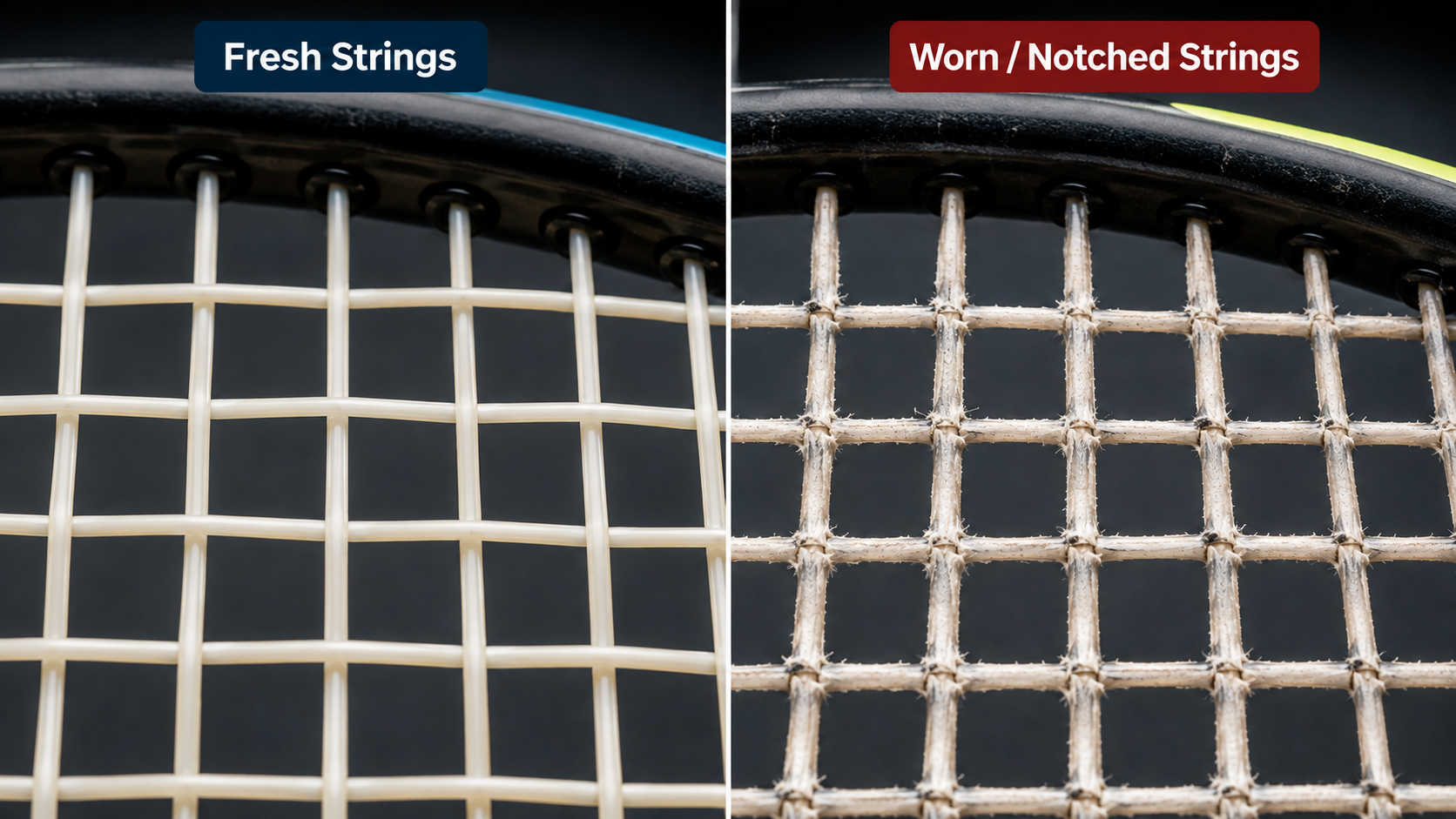
Tennis strings begin losing tension after they're installed, and repeated hitting continues to change the string bed over time.
Different materials also behave differently.
Polyester, multifilament, synthetic gut and natural gut don't lose tension, move or respond in exactly the same way.
So the physical change is real.
What is less certain is how accurately we feel it.
Research involving experienced recreational players has shown that players can have difficulty identifying surprisingly large differences in string tension simply by playing with the racquet.
That matters.
Because adult players are often told to judge strings with descriptions like:
“They've gone dead.”
“You've lost control.”
“The racquet doesn't have the same response.”
Those descriptions can be useful when you know your equipment extremely well.
But they can also become vague enough that you're looking for a feeling you're not sure you actually feel.
Instead of asking whether your strings feel old, ask something more useful:
Are they changing the ball you are producing?
That's a question you can actually test.

Try This Before Your Next Restring
The next time you're considering restringing, don't immediately cut the strings out.
Take the racquet onto the court first.
Spend 15 or 20 minutes testing three things you regularly need in matches.
1. Your second serve
Pick one target and hit 10 second serves.
Don't try to hit harder than normal.
Pay attention to your usual shape, height over the net and depth. Are you able to swing normally and still bring the ball down where you expect?
2. Your rally ball
Choose a crosscourt target several feet inside the baseline.
Hit 10–15 balls using your normal rally speed.
You're not testing whether you can hit the target once. You're looking for repeatability.
Does your normal swing consistently create your normal depth?
3. Your first four shots
Play points beginning with serve or return and continue through the next three balls.
This is where the equipment test becomes much more relevant to actual tennis.
Can you serve, recover and control the next ball?
Can you return and immediately play the next shot with the trajectory and depth you expect?
Now restring the racquet using the same string and the same requested tension.
Then repeat the test.
Don't change strings, tension and racquet at the same time.
If you change three variables, you won't know which one produced the difference.
You're looking for something very simple:
Does the fresh string bed allow me to produce my normal ball more consistently?
That is far more useful than deciding whether the racquet vaguely feels “better.”
Your Restringing Schedule Should Match Your Tennis
This is where universal restringing rules become difficult.
Imagine two adult players who both play three times per week.
One swings aggressively, creates substantial racquet-head speed and plays with polyester.
The other hits a flatter ball, swings more conservatively and uses a softer multifilament.
They may spend the same number of hours on court, but their strings aren't necessarily experiencing the same demands.
Their restringing needs don't have to be identical.
The same applies to the player.
Your needs may change depending on how you're training.
If you're doing more match play, working heavily on serves or training with greater intensity, you may start noticing changes sooner.
And sometimes the signal isn't a dramatic change in feel.
It may simply be that you're beginning to make small adjustments to produce a ball that used to come naturally.
You're swinging harder for depth.
You're guiding the second serve.
You're struggling to predict where a normally struck ball will land.
Those are more useful clues than the date on the calendar.
For serious adult players, equipment should support the tennis you're trying to play.
It shouldn't become another ritual performed simply because someone once gave you a restringing rule.
Fresh strings aren't magic.
Old strings aren't automatically useless.
The physical properties of a string bed change over time, but the important question is whether those changes have become meaningful for your game.
So before your next restring, don't ask:
“How long have these strings been in my racquet?”
Ask:
“Is this racquet still giving me the ball I expect when I make my normal swing?”
Test it.
Then restring.
Then test it again.
You might discover that fresh strings make a bigger difference than you thought.
Or you might discover that you don't need to restring nearly as often as someone else's schedule suggested.
Either way, you're making the decision based on your tennis rather than the calendar.
EXPLORE MORE