Should Adult Tennis Players Still Use a One-Handed Backhand?
The one-hander is disappearing from the professional game. That doesn't automatically mean it is the wrong backhand for your game.
For the first time in 149 years, no man with a one-handed backhand reached a Grand Slam semifinal.
That streak ended at the 2026 US Open when Stefanos Tsitsipas lost to Ben Shelton in the fourth round. The one-handed backhand has become increasingly rare in professional tennis, with only around 2–3% of competitors now using it.
So the obvious question for an adult player is:
Should I still be using one?
The answer isn't as simple as the professional numbers suggest.
If you're learning a backhand from scratch, or considering a major change, there are real reasons to consider the two-hander.
But if you've spent years developing a functional one-handed backhand, switching simply because the pros are using it less may not make much sense.
The better question is:
Which backhand gives you the best solutions for the way you actually play?
Why the Two-Hander Has Become So Popular
There is a reason the two-handed backhand has taken over modern tennis.
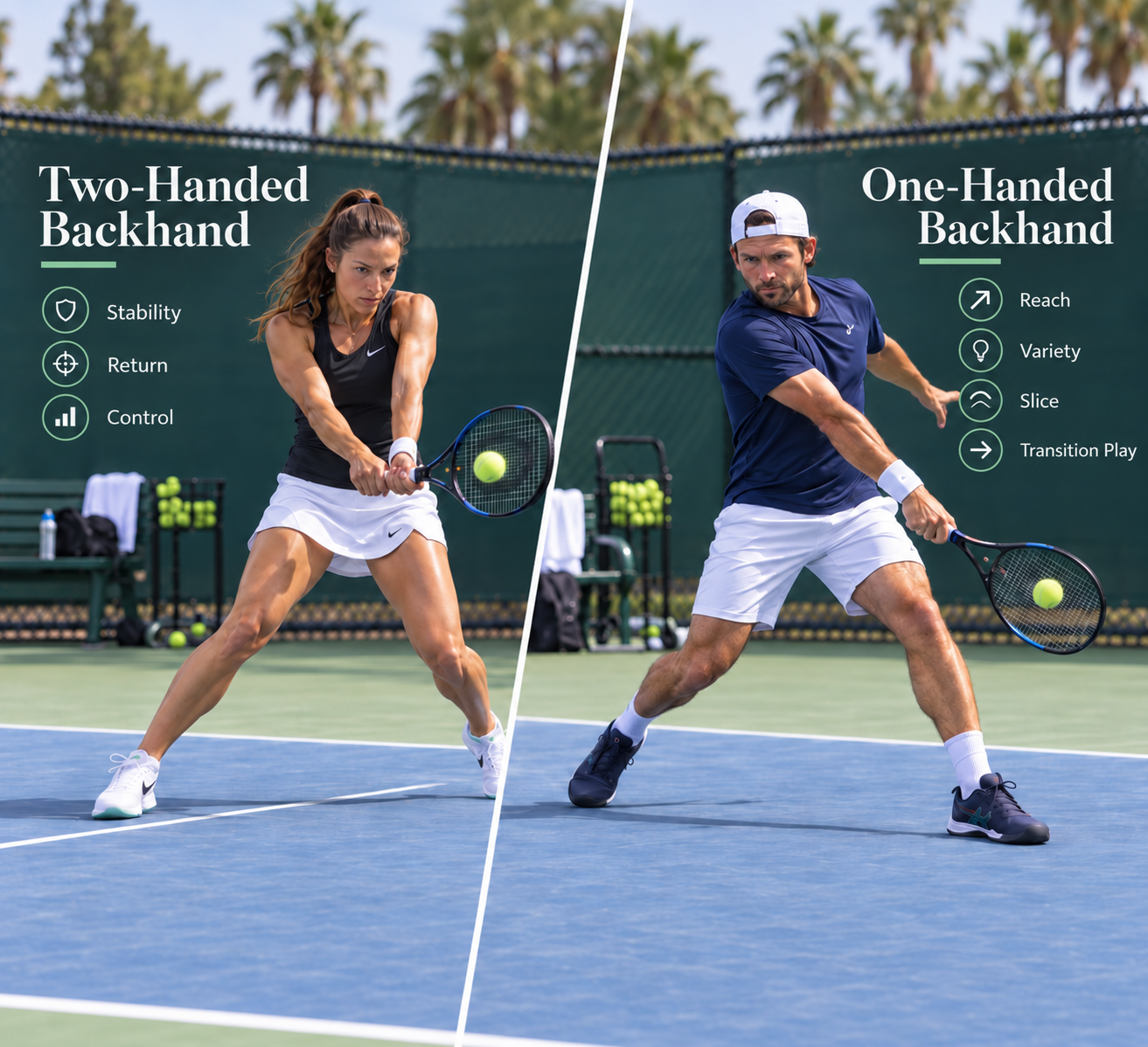
It generally gives players more stability and control, particularly when handling fast balls and returning serve. The shorter swing also makes it easier to manage situations where there is less time to prepare. The two-handed backhand is widely valued for its power, control, and effectiveness on service returns.
That matters even more in today's game.
Players hit harder.
Returns are faster.
Time is limited.
And adult players often have another challenge: they don't have unlimited hours to spend rebuilding a stroke.
For someone learning a backhand today, the two-hander can be a very practical choice.
But that doesn't make the one-hander obsolete.
What the One-Hander Still Does Well
The one-handed backhand has some useful tools that shouldn't be dismissed.
Reach is one.
A one-hander can extend farther outside the body, which can help when you're pulled wide.
Variety is another.
The stroke naturally connects with slice, approach shots, defensive lobs, drop shots and one-handed volleys.
Those options can become particularly useful for players who like changing pace, moving forward or using different trajectories.
And there is another advantage that is easy to overlook:
If the one-hander is already your natural stroke, you have years of experience behind it.
That matters.
A theoretically “better” stroke isn't automatically better for a player who has to spend months rebuilding their timing, preparation and confidence.
Research comparing the biomechanics of one- and two-handed backhands also shows that they use the body differently rather than simply being two versions of the same movement.
So this isn't really a question of which stroke is universally superior.
It's a question of what your game needs.
The Questions I Would Ask an Adult Player
If a player came to me asking whether they should switch, I wouldn't start with the pros.
I'd start with their match.
How is your backhand on the return?
This is a big one.
If fast serves consistently make you late or uncomfortable, the two-hander may give you a useful advantage because of its shorter, more stable swing.
What happens when the ball gets high?
A high, heavy ball to the backhand can expose timing and spacing problems with a one-hander.
If you constantly find yourself backing up or taking the ball late, that's worth addressing.
But don't immediately assume the solution is changing the stroke.
Sometimes the real problem is positioning and preparation.
What happens when you're pulled wide?
This is where the one-hander can be useful.
Its reach can help you handle balls outside your normal strike zone, particularly when you have enough time to organize the swing.
Do you actually use your slice?
If your game includes frequent slices, approaches, low balls and changes of pace, the one-handed backhand may fit naturally into that style.
If you never come forward and prefer heavy baseline exchanges, the advantages may be different.
How much time are you willing to spend changing?
This might be the most important question for an adult player.
Changing from one backhand to another isn't just changing where your second hand goes.
It changes preparation, spacing, timing, balance, return mechanics and what you do under pressure.
That is a significant training project.
Don't Switch Because the Pros Did
This is the biggest takeaway from the current one-handed backhand conversation.
Professional tennis is telling us something important:
The two-handed backhand is extremely well suited to the speed and demands of the modern game.
Even Lorenzo Musetti, one of the leading one-handed backhand players, has acknowledged that the two-hander offers efficiency advantages in modern tennis, particularly with the speed of play.
At the same time, Denis Shapovalov has argued that a highly developed one-hander can create certain angles that are difficult to produce with two hands.
Both can be true.
The two-hander may be the more practical choice for many players learning today.
The one-hander can still be an excellent choice for a player who has developed it well and knows how to build a game around it.
A Better Test Than “Which One Is Better?”
If you're thinking about changing your backhand, don't compare two perfect versions of the strokes.
Compare your actual versions.
Over a few practice sessions, test both against:
- First-serve returns
- High heavy balls
- Low balls
- Wide balls
- Down-the-line changes
- Crosscourt rallies
- Short balls
- Balls when you're moving backward
Then ask:
Which one gives me more reliable options?
Not which one looks better.
Not which one the pros use.
Not which one feels better after ten comfortable balls from a coach.
Which one survives when the ball is fast, high, wide, awkward and important?
That's the backhand that matters.
The One-Hander Isn't Dead. But It Has to Earn Its Place.
The professional game has clearly moved toward the two-handed backhand.
That trend is real.
But adult tennis is not professional tennis.
You don't need to copy the tour.
You need a backhand that fits your body, your time, your strengths and the problems you actually face in matches.
If you're starting from scratch, the two-hander deserves serious consideration.
If you've spent years developing a one-hander that gives you control, variety and confidence, don't throw it away because the numbers changed.
Instead, ask a better question:
Is my backhand helping me solve the problems my game actually faces?
If the answer is yes, keep building it.
If the answer is no, then it's worth exploring why—and whether the problem is the stroke itself or how you're using it.
The best backhand isn't the one that is most popular.
It's the one you can trust when the ball gets difficult.
EXPLORE MORE