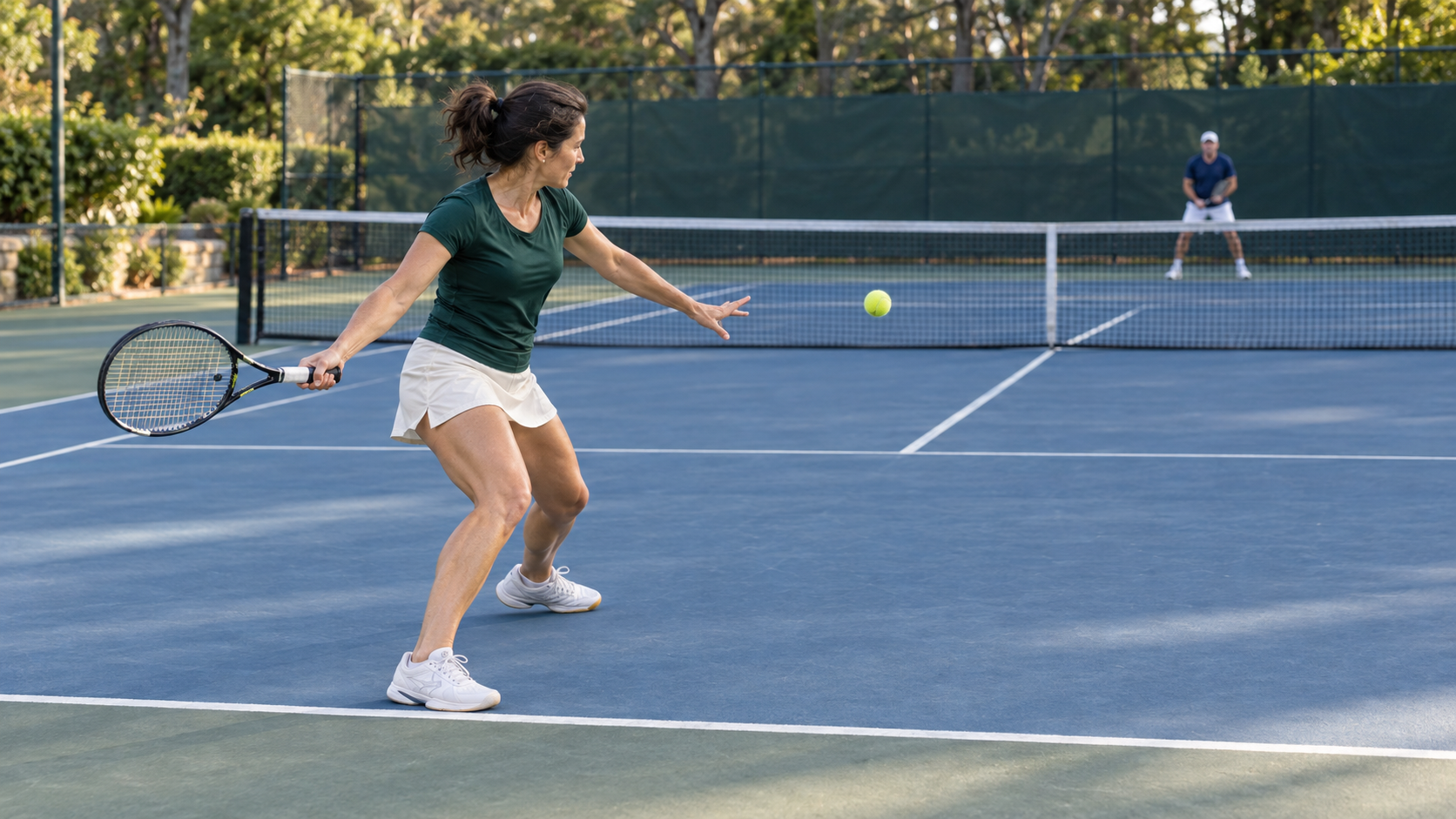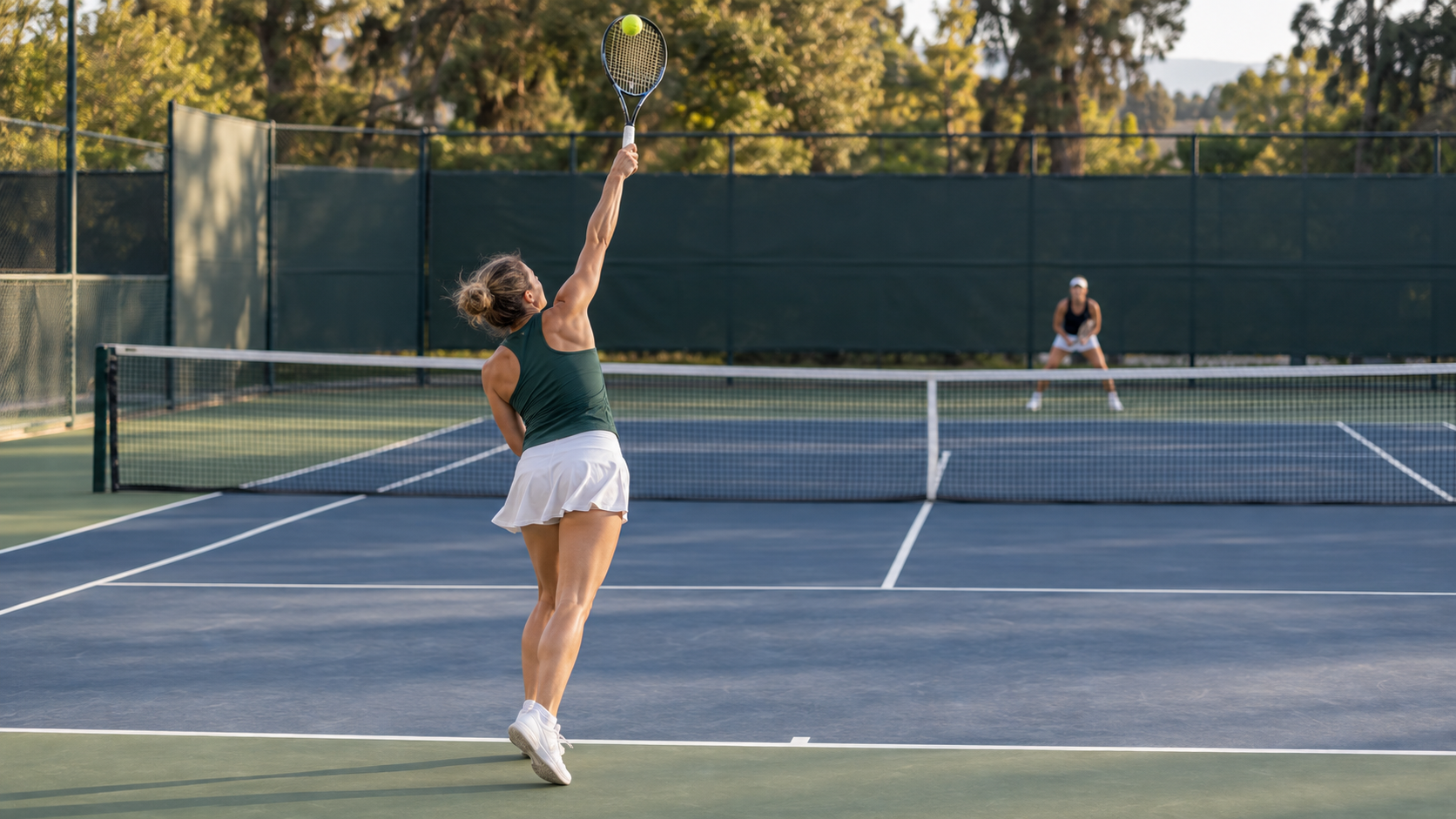
The First Four Shots: The Tactical Battle That Decides More Points Than You Think
Stop thinking about points as individual shots. Learn how the opening sequence creates your biggest opportunities.
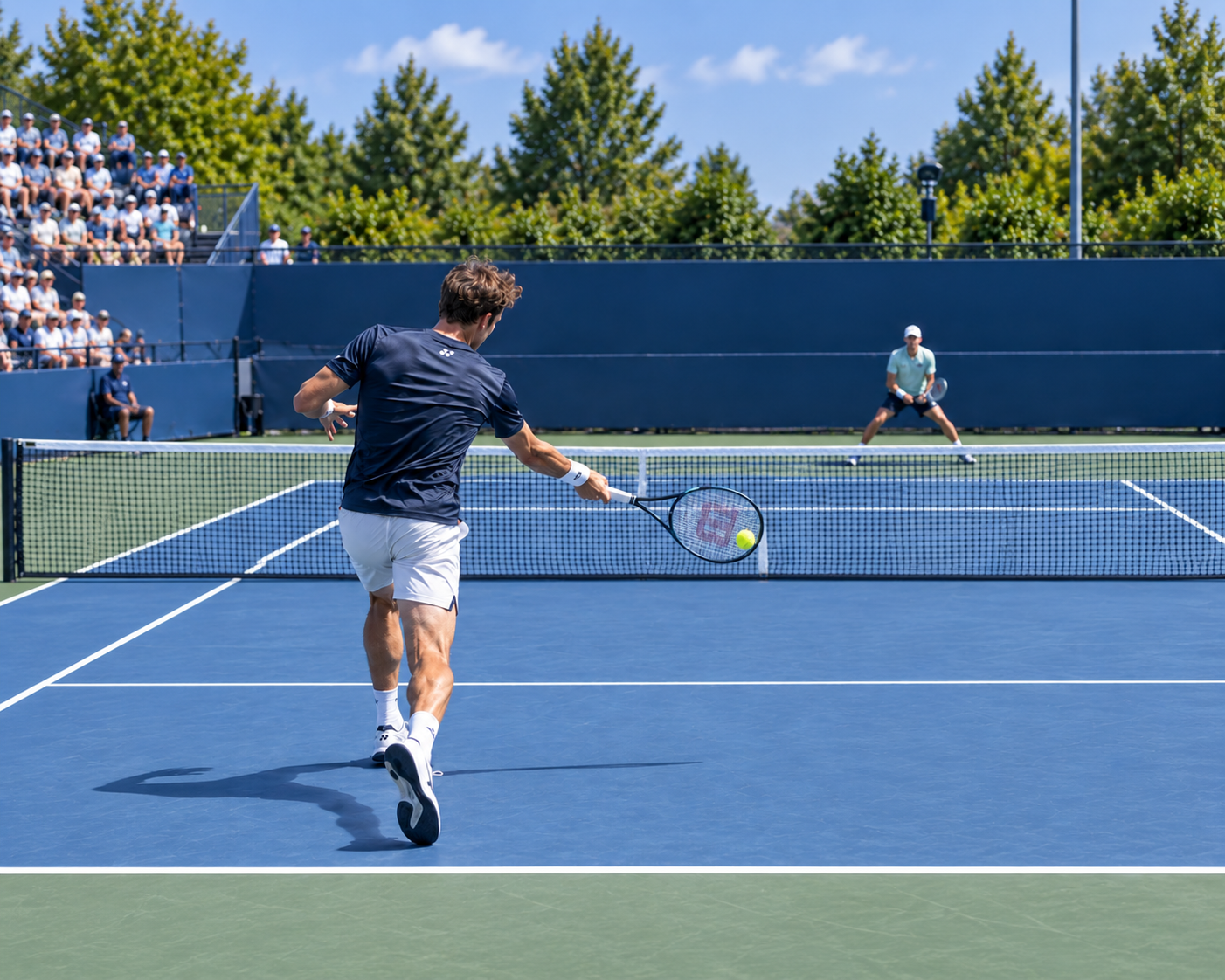
The final shot is not always what decides a tennis point.
The winner.
The volley.
The ace.
A lot of the time, the point is decided much earlier.
Before the highlight moment.
It starts with the opening sequence:
Where did the serve go?
What kind of return came back?
Was the first ball an opportunity, or did it put you under pressure?
When I work with players on court, I often remind them that tennis is not just about reacting to the ball in front of them.
The point is being shaped from the very beginning.
The first four shots often decide who starts with control:
Serve.
Return.
First attacking or neutral ball.
The next response.
How to Read the First Four Shots
Think about the sequence from your perspective.
If you're serving:
Your serve → their return → your Serve +1 → their Return +1
If you're returning:
Their serve → your return → their Serve +1 → your Return +1
You're not trying to control all four shots. You're learning to recognize what your shot creates and what your opponent's response gives you next.
That is the real value of the framework.
Tennis Is Decision vs. Decision
One of the easiest mistakes to make in practice is working on shots without connecting them to the point.
You hit serves.
You hit forehands.
You hit backhands.
You finish with volleys.
But a match does not ask whether you can hit a forehand.
It asks whether you can create the right forehand in the right situation.
That is a different skill.
A serve is not just a serve.
A return is not just a return.
Every shot changes what can happen next.
When I demonstrate this on court, I will often have a player serve wide and then stop the point after the return. We look at the court position, the height of the ball and the space that has opened up. The serve has already created a decision before the next forehand is struck.
That is why a player can sometimes look as though they have more time. The time was created by the decision before the ball arrived.
Shot One: Make Your Serve Create the Next Ball
It is easy to judge a serve by speed.
Was it fast enough?
Did it land in?
Did it trouble the returner?
Those details matter, but the bigger issue is the type of return the serve creates.
A wide serve is not only about reaching the corner.
It is about opening the court.
A body serve is not only about forcing an uncomfortable contact.
It is about taking away space and reducing the returner's choices.
A serve to the backhand is not automatically valuable because every backhand is weak. It becomes valuable when it gives you a predictable ball for the next shot.
The serve creates the opportunity.
The next shot has to use it.
Try This:
During your next serving session, do not track only first-serve percentage.
After each serve, note:
- What type of return did I create?
- Did I get the first ball I expected?
- Did the serve give me an advantage?
- Was I ready to use that advantage?
A serve can be technically good and still fail tactically if the next ball catches you unprepared.
Shot Two: Your Return Has a Purpose
A common return goal is simply:
Get the ball back.
That is a useful starting point, especially against a big first serve. But the return should also have a purpose.
The return helps determine the kind of point that follows.
Against a strong first serve:
- prioritize depth;
- avoid giving away a free attack;
- make the server play one more ball;
- start the rally on balanced terms.
Against a weaker second serve:
- step in;
- take time away;
- look for a deep, controlled target;
- make the server feel pressure immediately.
The first serve and second serve are different situations. They should not receive the same return plan.
On court, I often ask a player to return two serves from the same position: one first serve and one second serve. The swing may look similar, but the intention changes. Against the first serve, the goal may be to neutralize. Against the second, the goal may be to take control.
Try This:
Before each return, choose your goal.
First serve: Use a safe aggressive target.
Second serve: Step in and take control without forcing the shot.
Then judge the return by the point it created—not simply by whether it was a winner.
A deep return that starts a neutral rally can be a very good return. A flashy return that leaves you out of position may not be.
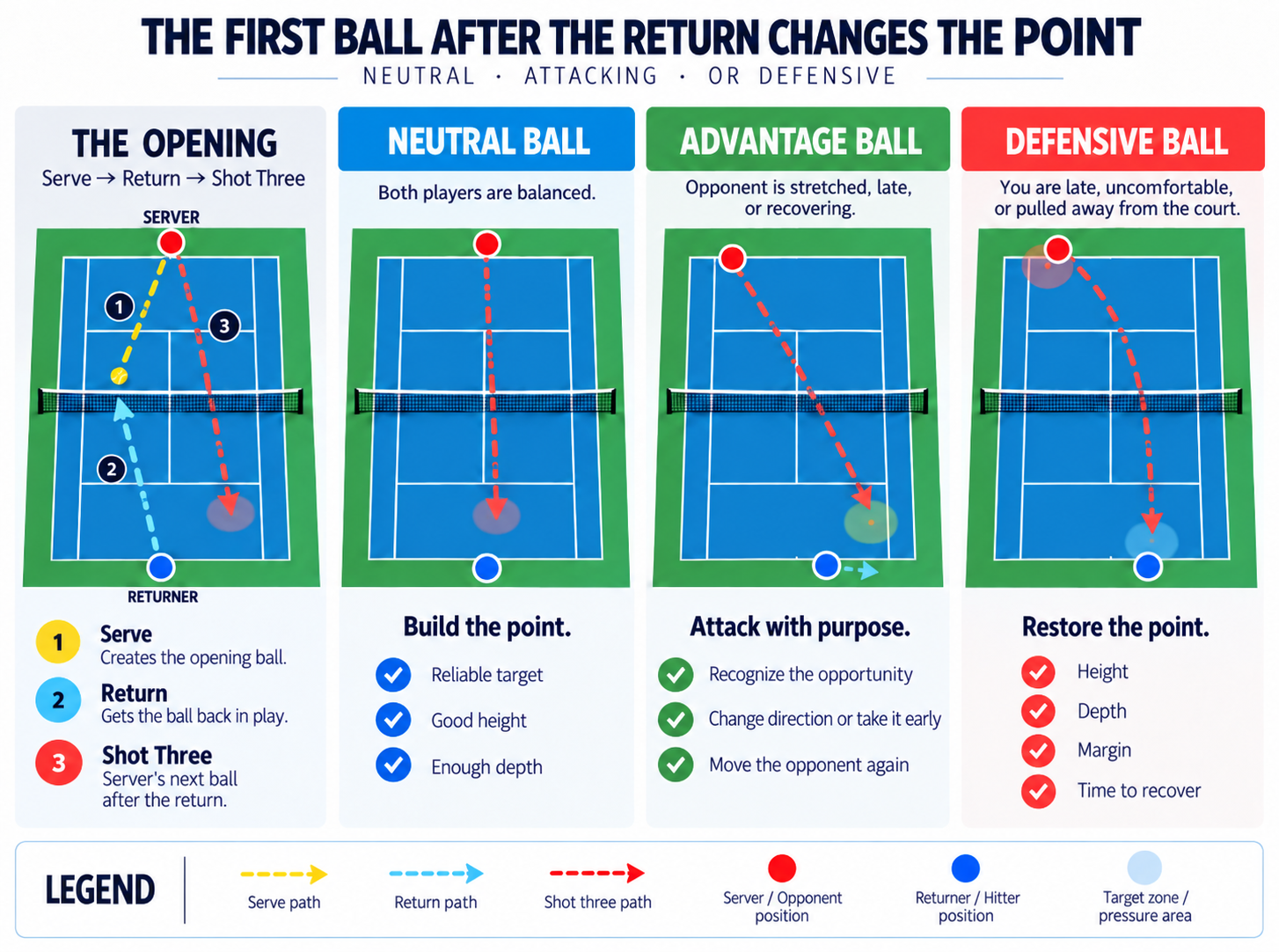
Shot Three: The First Ball After the Return Changes the Point
This is where a lot of points begin to slip away.
The serve was good.
The return was manageable.
Then the first ball after the return is hit without a clear decision.
That ball often determines whether the point stays neutral or begins moving in your direction.
I like to divide this moment into three situations.
Neutral Ball
Both players are balanced.
Nobody is clearly in trouble.
Your job is to build.
Use reliable targets, good height and enough depth to keep the opponent from taking over.
Advantage Ball
The opponent is stretched, late or recovering.
Your job is to recognize the opportunity and attack with purpose.
That does not always mean hitting as hard as possible. It may mean changing direction, taking the ball early or moving the opponent again.
Defensive Ball
You are late, uncomfortable or pulled away from the court.
Your job is to restore the point.
Use:
- height;
- depth;
- margin;
- a target that gives you time to recover.
The mistake is not attacking.
The mistake is attacking before the ball gives you permission.
During a court demonstration, I may feed the same player three different balls from the same area.
One ball is neutral, one is short and one is low and difficult.
The correct response changes each time.
The swing is not the only thing being trained. The decision is the real lesson.
Shot Four: Continue the Advantage
The Return +1 is your first shot after the server plays their Serve +1.
This is where you decide whether to
neutralize, defend, or turn the point back in your favor.
Here is a common example:
You return deep through the middle.
The server plays their Serve +1 to your backhand.
Now stop for a moment.
What kind of ball did you receive?
Are you:
- balanced with comfortable contact?
- being pushed back?
- stretched toward the sideline?
- receiving a shorter or weaker ball?
Your response should match the situation.
If you're under pressure, use height, depth and margin to get back into the point.
If the ball is neutral, build with a reliable target.
If the server gives you an opportunity, take space and attack.
The goal isn't to hit your Return +1 as hard as possible.
It's to recognize what the server's Serve +1 gives you—and make the right decision with it.
Stop Treating Every Point as Random
Good match play is built around patterns.
You begin to notice things such as:
“If I serve here, I often get this reply.”
“If I return here, I usually get this ball.”
“If I open the court, I need to be ready for the next space.”
“If I hit behind the opponent, I may get the shorter ball.”
Tennis should never become completely automatic.
The opponent can always change the picture.
But you can train yourself to recognize familiar situations sooner.
That is the value of working on the first four shots.
You are not trying to predict every point perfectly.
You are learning to see the likely options before the point becomes chaotic.
Research in tennis performance highlights the importance of serve, return and early-point performance in shaping match outcomes.
The practical lesson is simple: improving the beginning of the point can create more opportunities before a long rally even develops.
Your Next Match Challenge
For your next match, track the first four shots.
You do not need complicated statistics. After each game, review the opening sequence:
On serve:
Did my serve create the return I wanted?
On return:
Did I neutralize the serve or create pressure?
First ball:
Was I building, attacking or defending?
Fourth shot:
Did I continue the advantage?
After a few games, you will start seeing the match differently.
You will notice that some points were lost before the final error.
You will also notice that some points became easier because the serve, return and first ball were connected.
Tennis is not only about hitting better shots.
It is about creating better situations.
Many of those situations begin before the rally really starts.
The Point Starts Before the Point
It is tempting to spend all your time working on the last shot of the point.
The winner.
The finishing shot.
The highlight.
But better tennis often starts earlier.
The serve creates the return.
The return creates the opportunity.
The first ball creates pressure.
The next decision keeps the advantage.
When you learn to recognize and train those first four shots, the rest of the point becomes easier to understand—and much easier to play.
EXPLORE MORE