The 5 Skills That Move You Toward a Reliable 3.5 Game
The next level is not about hitting harder. It is about making better decisions with the shots you already have.
A lot of players think the jump to the next level happens when they add something new.
A bigger forehand.
A faster serve.
A more aggressive style.
A new technique that suddenly makes everything easier.
But for many players trying to move toward a reliable 3.5 game, the biggest improvement does not come from adding more weapons.
It comes from making the shots they already have more dependable.
A 3.5 player is not someone who hits every ball perfectly.
They are someone who can:
- control direction;
- create depth;
- handle moderate pace;
- recognize attackable opportunities;
- recover with purpose;
- make better decisions under pressure.
The difference is not the occasional highlight shot.
It is how many situations they can handle when the match becomes uncomfortable.
Skill 1: Control the Direction of the Rally
One of the biggest changes from developing player to 3.5 is understanding that every ball has a purpose.
Many players judge a successful shot by one question:
Did it go in?
Better players ask:
Where did it go, and what did it create?
A neutral ball in the middle of the court does not create the same situation as a deep crosscourt ball that pushes an opponent outside the court.
The direction of your shot starts creating the next decision.
Tactical Lesson: Build One Reliable Pattern
Instead of trying to hit every shot differently, build one pattern you trust.
Example:
Backhand crosscourt → opponent replies shorter → move inside → attack with forehand
Or:
Heavy forehand crosscourt → recover → wait for the shorter ball
The goal is not to win the first shot.
The goal is to create a predictable advantage.
Many 3.0 players are trying to end points.
Many 3.5 players are learning how to build them.
Try This:
Play points where you only attack after creating the same situation twice.
Example:
First two balls:
Crosscourt.
Third ball:
Attack only if the opponent gives you a shorter or weaker reply.
You are training patience and recognition not just aggression.
Skill 2: Know When to Defend, Build, and Attack
A major tactical jump happens when players stop seeing every ball as either:
“Hit a winner.”
or:
“Just keep it in.”
There is a third option:
Build.
Defensive Ball
Examples:
- You are stretched wide.
- You are moving backward.
- Contact is uncomfortable.
Your job:
Create time.
Use:
- More height.
- More spin.
- Bigger targets.
- More margin.
Neutral Ball
Examples:
- You are balanced.
- You have comfortable contact.
- Your opponent has not created an advantage.
Your job:
Build pressure.
Don't force.
Make them solve another ball.
Attackable Ball
Examples:
- Short ball.
- Floating ball.
- Opponent recovering late.
Your job:
Move forward.
Take time away.
Change the point.
A common mistake among improving players is attacking because a ball is “short.”
But a short ball is only an opportunity if you can control the next situation.
The better question is:
Did the ball give me permission to attack?
Skill 3: Make Your Serve Create the Next Ball
Many developing players think about the serve as a way to start the point.
A 3.5 player should start thinking about the serve as the first tactical decision.
The question changes from:
“How do I hit a harder serve?”
to:
“What return am I trying to create?”
Example:
Wide Serve
Purpose:
Create space.
Expected response:
Crosscourt return.
Next decision:
Attack the open court.
Body Serve
Purpose:
Reduce the returner's options.
Expected response:
Blocked or shorter return.
Next decision:
Step forward and take control.
Second Serve
This is where many players give away opportunities.
A second serve should not simply be:
“Get it in.”
It should have:
- reliable spin;
- dependable height;
- a target;
- enough quality that the opponent cannot attack comfortably.
A simple practice idea:
Play service games where your goal is not aces.
Your goal:
Win the first four shots.
Serve.
Return.
First ball.
Next ball.
Many points are decided before the rally even develops.
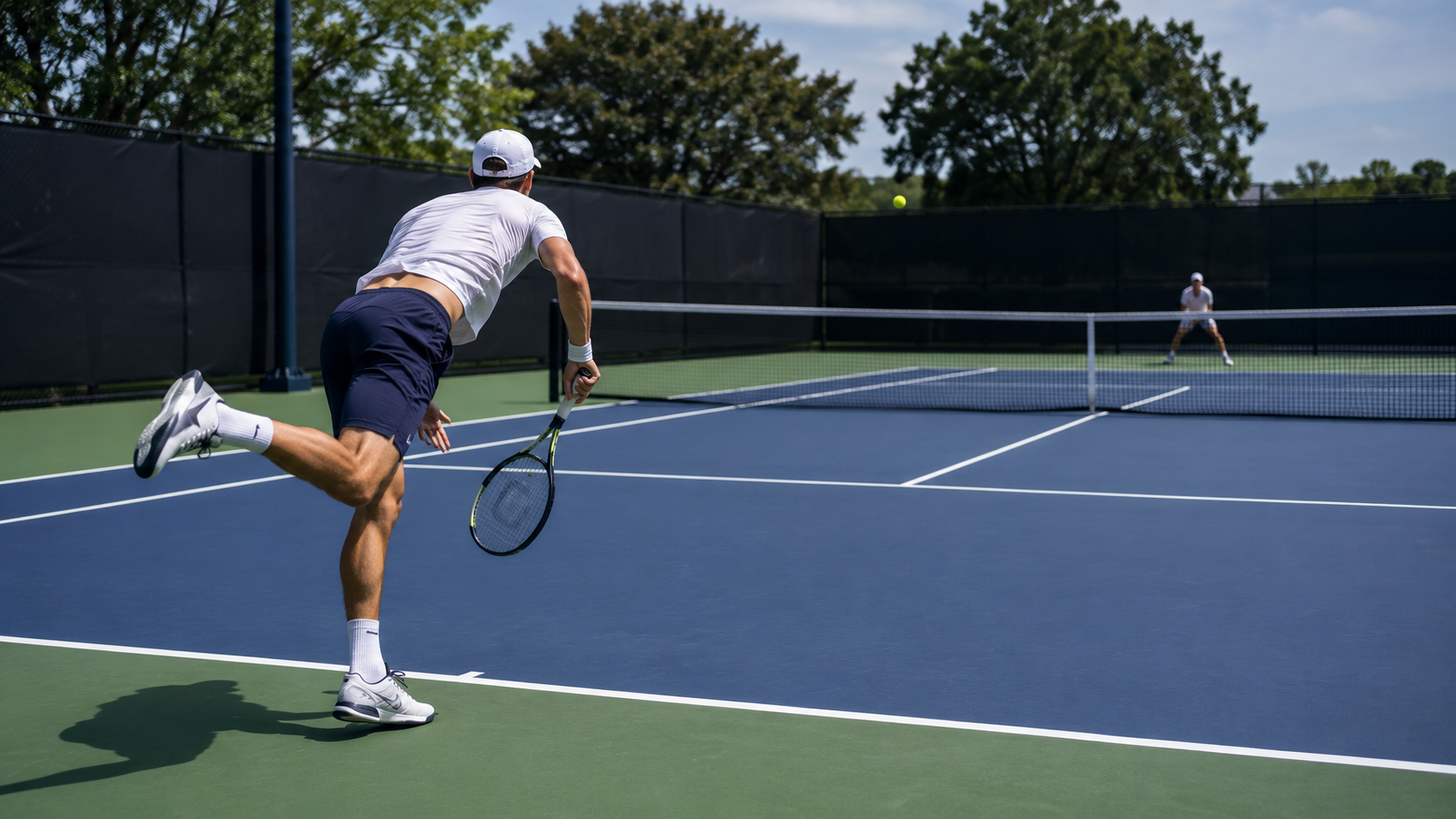
Skill 4: Recover With a Purpose
Many players improve their strokes but remain stuck because they do not improve what happens after the shot.
They hit a good ball.
Then they watch.
Better players are already preparing for the next reply.
The common advice is:
“Recover to the middle.”
But that is incomplete.
The better question is:
Where is my opponent most likely to hit next?
Your recovery depends on:
- where you hit;
- where your opponent is;
- what options they actually have.
Example:
You hit a strong crosscourt forehand and your opponent is stretched wide.
Their easiest reply is probably not a perfect down-the-line winner.
It is usually a higher percentage recovery ball.
Recover for the realistic reply.
Not the imaginary one.
Skill 5: Develop a Reliable
Match Identity
A lot of players trying to improve think they need more variety.
They add:
- drop shots;
- slices;
- different spins;
- risky patterns.
But variety without purpose creates confusion.
A better player knows:
What type of point do I want to create?
Maybe your identity is:
“I use my forehand to control the middle of the court.”
Or:
“I use my serve and first ball to take time away.”
Or:
“I stay patient until I get a short ball.”
Your game does not need every option.
It needs a few things you trust.
Tactical Test:
After a match, ask:
What did I want my opponent to feel uncomfortable doing?
If you don't know the answer, your game may need a clearer identity.
The 3.5 Player Checklist
Before your next level-up goal, ask:
Can I...
Control rally direction?
Not just keep the ball alive.
Recognize the difference between defensive, neutral, and attackable balls?
Not attack everything short.
Create a serve + first ball pattern?
Not simply start points.
Recover based on my opponent?
Not automatically move back to the center.
Trust a repeatable game plan?
Not change strategy every few points.
The Next Level Is Built Through Better Decisions
The jump toward a reliable 3.5 game is not about collecting more shots.
It is about making your existing shots more useful.
A better player is not simply the person with the biggest forehand or fastest serve.
It is the player who understands:
Which shot.
When.
Why.
And what comes next.
That is the difference between hitting tennis balls and actually building points.
EXPLORE MORE